Can You Trust Your Rank Tracker Right Now?
Short answer: partly. Since mid-September 2026, several rank tracking vendors have reported that Google sends some automated requests a results page that looks normal but lists the wrong sites. The industry calls these poisoned SERPs. Most vendors say they now filter out the bulk of them. Then Google started the November 2026 core update on 10 November, which is the one week you most want clean ranking data.
So I’ve changed how I judge rank tracker accuracy and read SEO reports for now. Search Console leads, the rank tracker becomes a second opinion, and every chart gets annotated. Below: what’s confirmed, what isn’t, and the report I’d build instead.
What “poisoned SERPs” means
A poisoned SERP is a complete Google results page, served to a request Google suspects is a bot, with most of the usual organic results swapped for other sites. There’s no CAPTCHA and no error. The tracker gets a normal-looking page and stores it as a real ranking. Trackers know to retry a blocked request. Nothing tells them to retry a poisoned one.
Rank tracker Nozzle has published the most detailed numbers. In its Poisoned Google SERPs study (updated 3 November 2026), requests to Google started failing in large numbers on 13 September, and altered pages started arriving on 20 September. Among SERPs it judged on both pages, page 1 or page 2 was poisoned on 68.6% of them on 2 November, its worst day so far. On poisoned pages, a tracked project’s own site missed the top 10 63.7% of the time, against 2.6% before. Search Engine Roundtable’s coverage (12 October, updated since) adds that social sites and forums tend to fill the gap.
Other vendors have published their own figures:
- Ahrefs said on 22 October it saw 5% to 20% of search results affected, depending on the data provider. Its 6 November update says page one data is “largely recovered and stable,” while some page two and beyond results are still being rejected and refreshed.
- Semrush said on 27 October that it excludes clearly invalid results and re-collects flagged ones, and told users to compare unexpected ranking changes against their own data, such as Google Search Console.
- AccuRanker reported that on 24 October Google poisoned 40% of its first desktop fetches. After its checks, 3.2% of desktop keywords in its sample still had a swapped page 1.
- DataForSEO, which sells SERP data to other tools, launched an opt-in
resolve_poisoned_resultssetting on 16 November. It checks page one against Google’s Web filter view and costs one extra SERP page per task.
What’s confirmed and what’s still open
Confirmed enough to act on: several vendors independently describe the same pattern, and they’re all spending more requests to work around it. Not confirmed: why it’s happening. Google hasn’t commented publicly, as Semrush noted on 27 October. The common theory, repeated by Semrush, Nozzle and Search Engine Roundtable, is that Google is fighting bulk scraping for AI systems and rank trackers got caught in the middle. It’s plausible but unconfirmed, and Google could change the behaviour at any time.
Why this week is the worst time to trust one tool
Three things overlap right now:
- The November 2026 core update started on 10 November, and Google says the rollout may take up to two weeks.
- Google confirmed a logging error that lowered impressions in Search Console’s Generative AI performance report for 9 to 11 November. Its data anomalies page says the issue “affects data logging only.”
- On 16 November, Search Engine Roundtable called core update chatter more muted than usual, partly blamed tracking tools that are struggling, and noted Search Console’s performance reporting had been “a bit laggy.”
Put those together and a one-day drop in your tracker could be the update, a poisoned page, or both. You can’t tell which from the tracker alone.
Search Console isn’t clean either
Rank tracking vs Search Console isn’t a clean swap, because Search Console has its own limits:
- Average position isn’t a live rank. Google’s help page on impressions, position and clicks says it’s the topmost position your link held, averaged across impressions, and a position is only recorded when the result gets an impression.
- Logging bugs happen. The 9 to 11 November error above is the latest one, and Google keeps a running list on the anomalies page.
- Writing for Search Engine Land on 3 November, Ryan Jones argued that trackers re-checking the same keyword several times could push extra bot impressions into Search Console, inflating impressions and dragging CTR down. That’s a hypothesis, not a measured effect. It’s still a good reason to read clicks before impressions.
Nozzle’s Derek Perkins made a similar point in a Women in Tech SEO AMA, summarised on Nozzle’s blog: treat Search Console as one data point and use your own site analytics as the most stable baseline. I agree, so “Search Console-first” here means it leads the report, with analytics and the tracker beside it.
The Search Console-first report I’d use instead
This is the weekly report I’d send a client, or myself, until the vendors and Google settle down. Seven blocks, in this order.
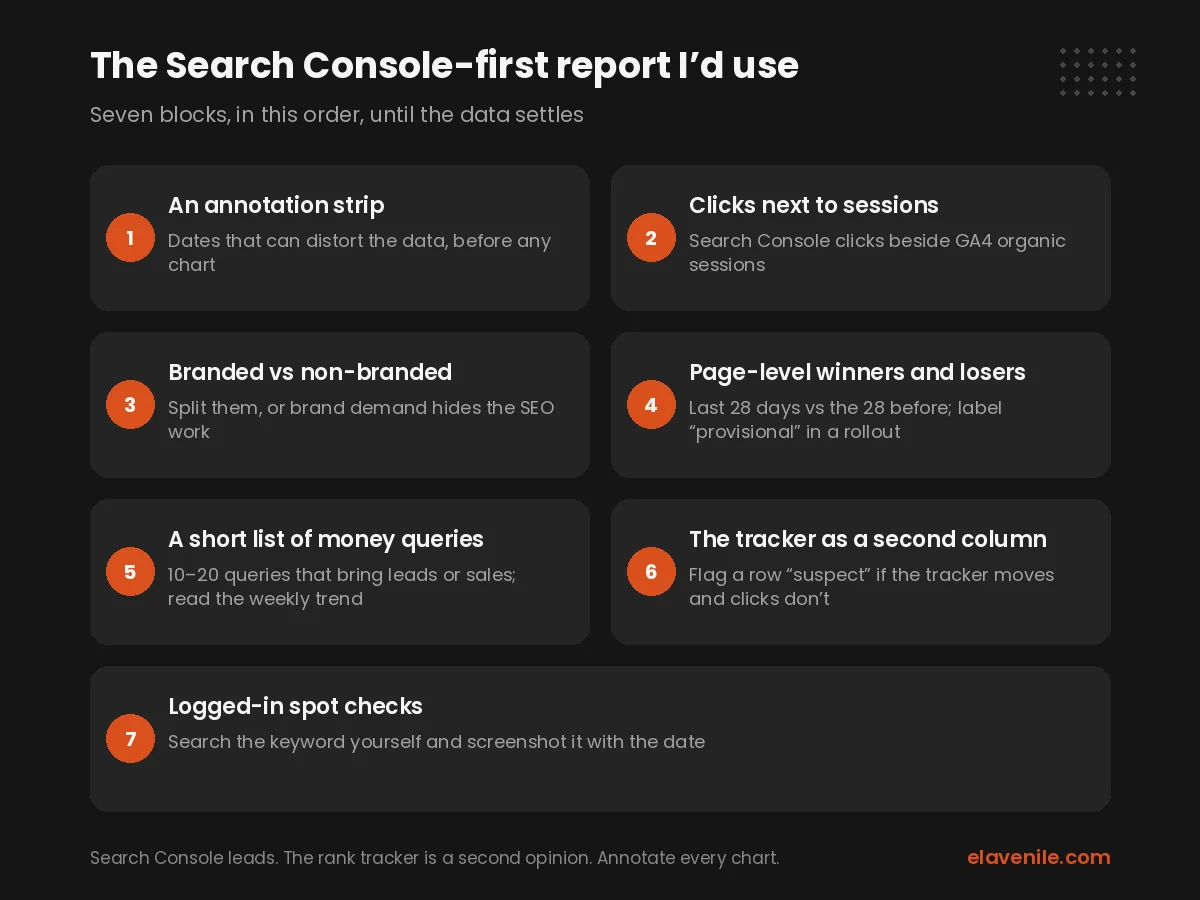
1. An annotation strip
Before any chart, list the dates that can distort the data. Right now that’s 13 September (tracker requests start failing, per Nozzle), 20 September (altered pages start), 9 to 11 November (Generative AI report logging error) and 10 November onward (core update rollout).
2. Clicks next to analytics sessions
Weekly clicks from Google Search Console, next to organic landing-page sessions in Google Analytics 4. If both are flat, your traffic didn’t fall, whatever the tracker says. If you also want to see what ChatGPT and other AI tools send you, I walk through that setup in my guide to tracking AI traffic in GA4.
3. Branded vs non-branded
Search Console’s branded queries filter splits brand and non-brand performance for eligible top-level properties. Since 16 November, the same split is in the Search Analytics API, so it can feed a dashboard directly. Brand demand moves for reasons outside SEO, so mixing it with non-brand hides what your SEO work did.
4. Page-level winners and losers
Pages are what you’ll fix, so report at page level. Compare the last 28 days with the 28 before: the ten pages that gained the most clicks and the ten that lost the most. During a core update rollout, I’d label this “provisional” until Google marks the update complete.
5. A short list of money queries
Pick 10 to 20 queries that bring leads or sales, and show weekly clicks and average position for each. Read the weekly trend, not a single day. Queries with few impressions will swing around, so mark low-volume rows instead of reacting to them.
6. The rank tracker as a second column
Keep the tracker’s positions in a column beside Search Console. Flag a row as “suspect” when the tracker shows a big one-day move and Search Console clicks for that page didn’t move. Trackers still cover competitor positions, SERP features and local grids, which Search Console doesn’t, so I’d keep them for that.
7. Logged-in spot checks for anything big
For the handful of rows that matter, search the keyword yourself and screenshot it with the date. Nozzle says it hasn’t seen evidence of poisoning in logged-in results, which makes a manual check the closest thing to a clean reference right now. That’s Nozzle’s observation, and one search is one sample.
How to tell a poisoned drop from a real drop?
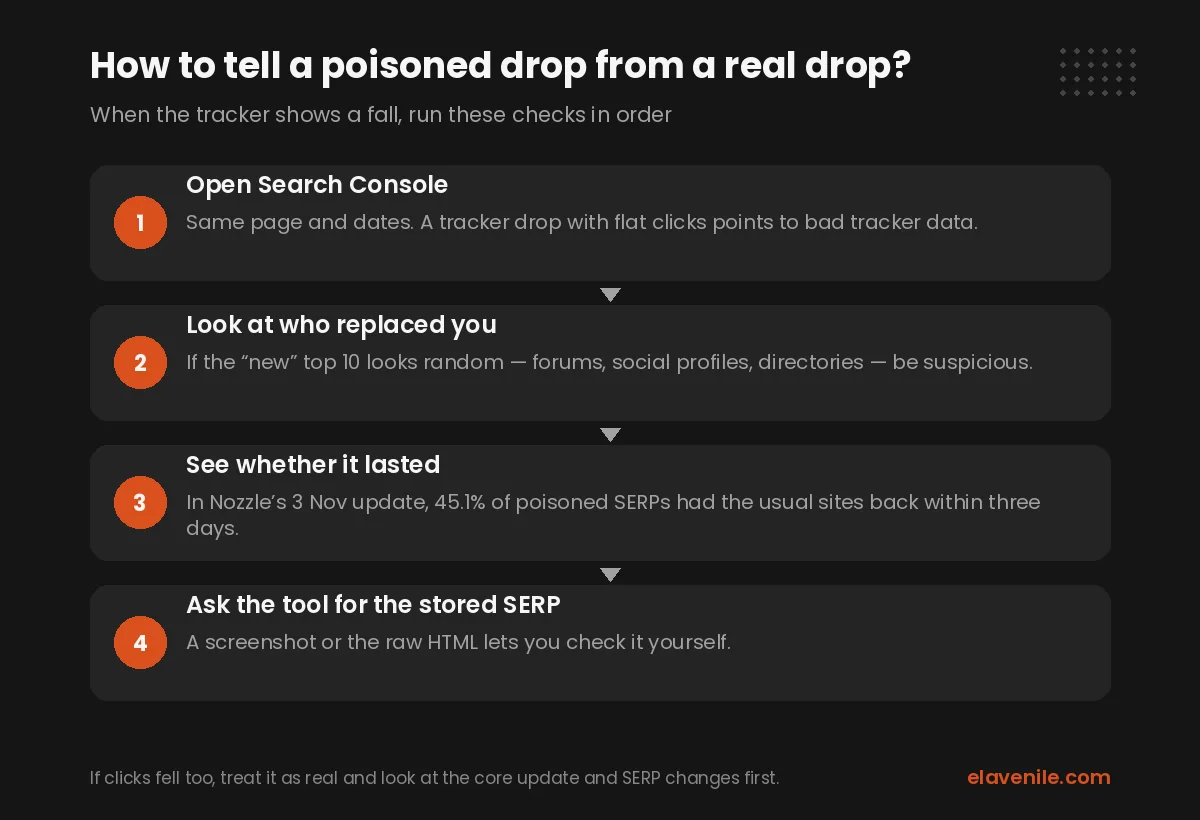
When the tracker shows a fall, I’d run these checks in order:
- Open Search Console for the same page and dates. A tracker drop with flat clicks points to bad tracker data.
- Look at who replaced you. Trade press coverage describes poisoned pages filling up with forums, social profiles and directories. If the “new” top 10 looks random for the query, be suspicious.
- See whether it lasted. In Nozzle’s 3 November update, 45.1% of poisoned SERPs had their usual sites back within three days. AccuRanker flags a day whose top 10 keeps fewer than half the sites from both the day before and the day after.
- Ask the tool for the stored SERP. A screenshot or the raw HTML lets you check it yourself.
- If clicks fell too, treat it as real and look at the core update and SERP changes first. AI Overviews can take clicks without any rank change, which I cover in my AI Overviews opt-out guide.
Questions to ask about rank tracker accuracy
Nozzle suggests four questions for any provider. I’d send them to whichever tool you pay for:
- How do you detect a poisoned SERP?
- What happens when you find one? Is it collected again, flagged or kept?
- What about new keywords with no ranking history to compare against?
- Can I see the SERP you collected?
Here’s what the main vendors have said publicly so far. These are vendor statements. I haven’t found an independent accuracy test that covers all of them.
| Tool | What it has said publicly | Date |
|---|---|---|
| Ahrefs | 5% to 20% of results affected depending on data provider; filters abnormal results and requests replacements; page one “largely recovered and stable” | 22 Oct, updated 6 Nov |
| Semrush | Excludes clearly invalid results, re-collects flagged ones, suggests checking against Search Console; no rate published | 27 Oct |
| AccuRanker | Re-fetches suspicious pages and compares with recent history; 40% of first desktop fetches poisoned on 24 Oct, 3.2% of keywords after checks | 19 Oct, updated |
| SE Ranking (via Search Engine Roundtable) | Fixes in place; about 2% of tracked results still affected at the time | 16 Oct |
| Nozzle | Re-collects a suspect keyword up to five times through different proxy networks; keeps raw HTML of every SERP | 11 Nov |
| DataForSEO | Opt-in check against Google’s Web view; repaired results marked; costs one extra SERP page per task | 16 Nov |
Fairly put, vendors that publish rates and let you see stored SERPs are easier to trust, but every figure in that table is self-reported. Extra checks also cost money, which tends to land in your plan price. New keywords are the weak spot for history-based checks, because there’s nothing to compare against yet.
FAQ
What are poisoned SERPs?
They’re Google results pages, served to suspected automated requests, that look normal but swap most of the usual organic results for other sites. Rank trackers can store them as real rankings, which shows up as false drops.
Has Google confirmed it’s poisoning results for rank trackers?
No. As of 18 November 2026, Google hasn’t commented publicly. The evidence comes from vendor data from Nozzle, Ahrefs, Semrush, AccuRanker and others, covered by trade press. Why Google is doing it is still a theory.
Is Search Console more accurate than a rank tracker?
It measures something different: impressions and clicks from Google’s own logs, with an averaged position. That makes it a better baseline right now, but it still has logging bugs and averaging limits, so pair it with your site analytics.
Should I cancel my rank tracker?
Not by default. Trackers still show competitors, SERP features and local positions that Search Console doesn’t. Ask your vendor how it detects poisoned pages, and move its data to a second column in your report.
Which dates should I annotate in SEO reports?
From 13 September 2026 onward for tracker data, 9 to 11 November for Search Console’s Generative AI report, and 10 November onward for the core update rollout.
What I’d do this week
Add the annotation strip to every report today, move clicks to the top, and send your tracker vendor the four questions. Then wait for Google to mark the core update complete before naming winners and losers.
If you want help setting up a Search Console-first report, or a technical SEO check once the update settles, take a look at my growth and technical SEO services. If your site is new and Search Console is still mostly empty, start with my 90-day plan for a new blog.