Search Console vs Rank Trackers: The Weekly Checks I Trust
I don’t start the week in a rank tracker any more. Not because rank tracking is useless, but because it is the easiest chart in the stack to misread.
Search Console vs rank trackers is not a contest to pick a winner. Search Console reports how Google showed your site to real searches, and whether people clicked. A rank tracker estimates where you sat on a results page, usually by sending its own queries. Those are different jobs. When the two disagree, I start with Search Console, then I ask whether the tracker is describing a real move or a measurement problem.
I already wrote about one of those problems in Can You Trust Your Rank Tracker Right Now?: poisoned SERPs, and the extra noise that arrived with the November 2026 core update. This post is the weekly routine I use after that piece. These are the checks I trust, and why Search Console leads them.
What each tool is actually good for
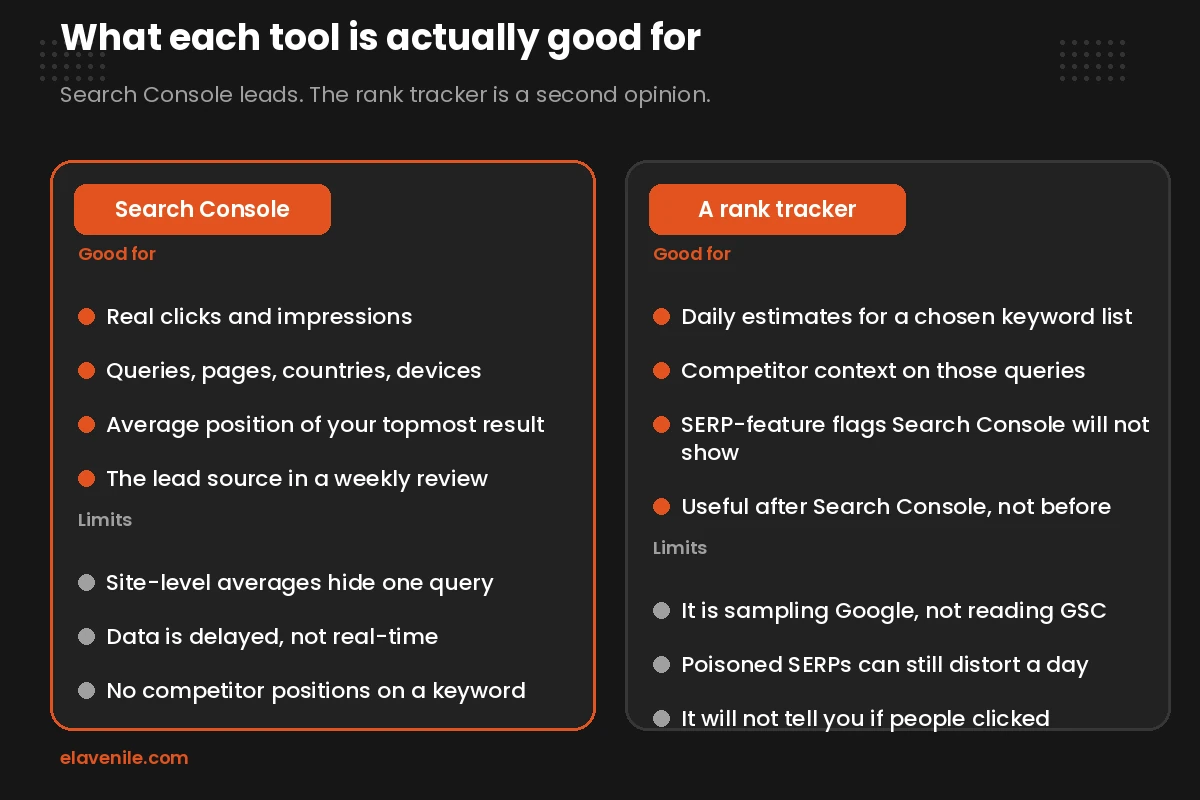
Search Console’s Performance report is built around four numbers: clicks, impressions, click-through rate, and average position. Average position, in Google’s wording, is “the average position of the topmost result from your site.” In the chart, that average is for the whole site. In the table, it is for the URL or grouping you selected. The data comes from real searches, which is why I treat it as the lead source. It is also why I do not treat a site-level average as a verdict on one keyword.
A rank tracker is still useful, just for a narrower job. It can show daily estimates for a keyword list you already care about, including competitors on those same queries, and it can flag SERP features you would not see in Search Console’s click and impression totals. It cannot tell you how often real people saw you, and it is not a copy of your Search Console data. If a vendor is sampling Google, it can also pick up the poisoned results I described in the earlier post.
So I do not ask “which tool is right?” I ask “what is this number averaging?” A tracker that says position 7 and a Search Console row that says position 16 can both be describing something real, because they are almost never averaging the same set of queries.
The weekly checks I trust
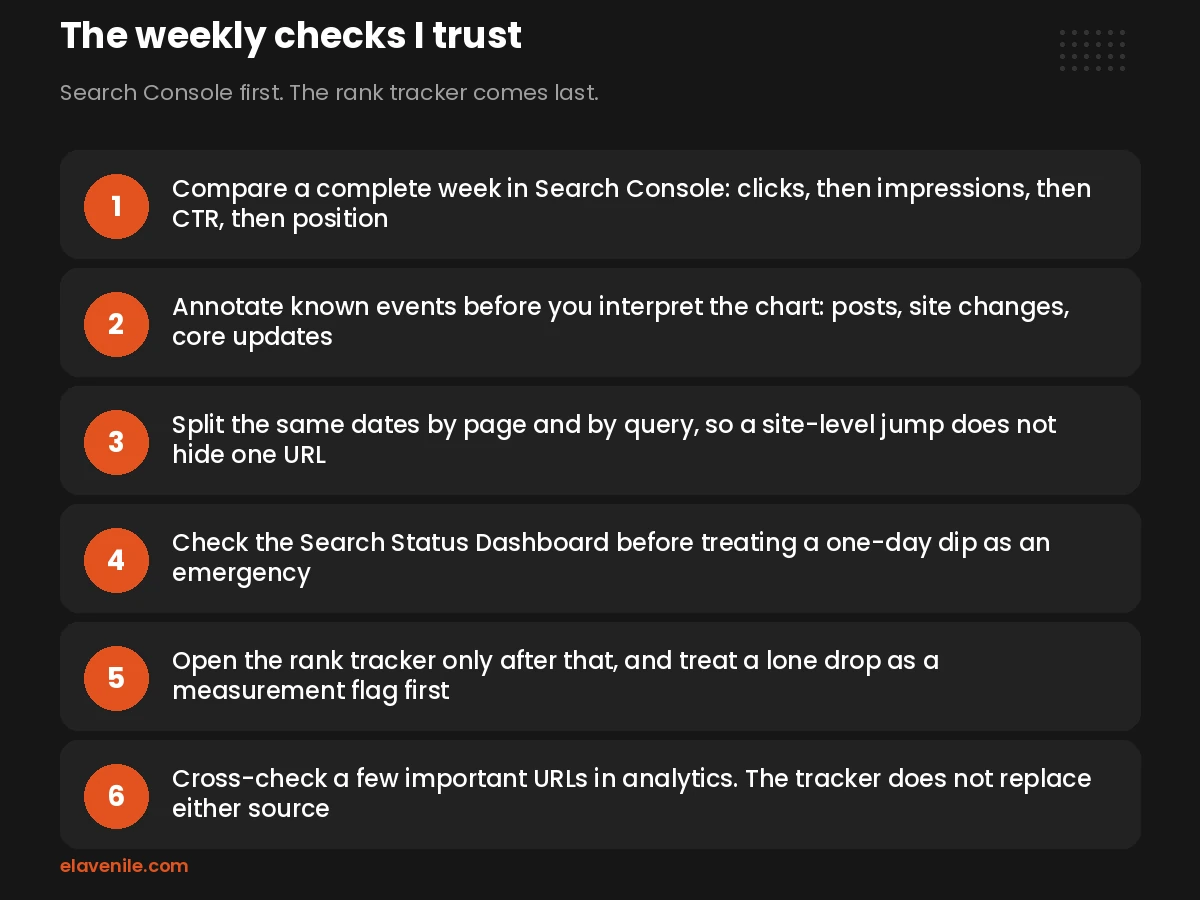
This is the order I work in. I keep it short enough that I will actually do it.
- Open Search Console Performance for a complete week, not a partial day. Compare that week with the week before, and with a week from earlier in the month. I look at clicks first, then impressions, then CTR, then average position. Position last, on purpose. It is an average, and it moves when the mix of queries changes, even if no important URL has “fallen off.”
- Annotate known events before I interpret the chart: a new post, a template or redirect change, a core update start or end date. If I skip this step, I will invent a story that fits the line.
- Split the same date range by page and by query. A site-level impression jump can be one new URL, or one country, or one cluster of branded searches. I do not congratulate (or panic about) “the site” until I know which URLs moved.
- Check the Search Status Dashboard before I treat a one-day dip as a ranking emergency. If Google is rolling out a core update, or has an incident open, I mark those dates and I wait.
- Only then do I open the rank tracker. If a tracked keyword dropped hard, and Search Console clicks and impressions for that query, or close variants, did not, I treat it as a measurement flag first. The diagnostic I use for that is in the rank tracker accuracy post.
- I cross-check a handful of important URLs in analytics. For visits from AI assistants I use the method in How to Track AI Traffic in GA4. Ordinary organic still lives in Search Console and analytics together. The tracker does not replace either of them.
A worked example from my own Search Console
Here is how that routine looks on my own site, with numbers from Google Search Console, not from a rank tracker, and not from guessed search volumes.
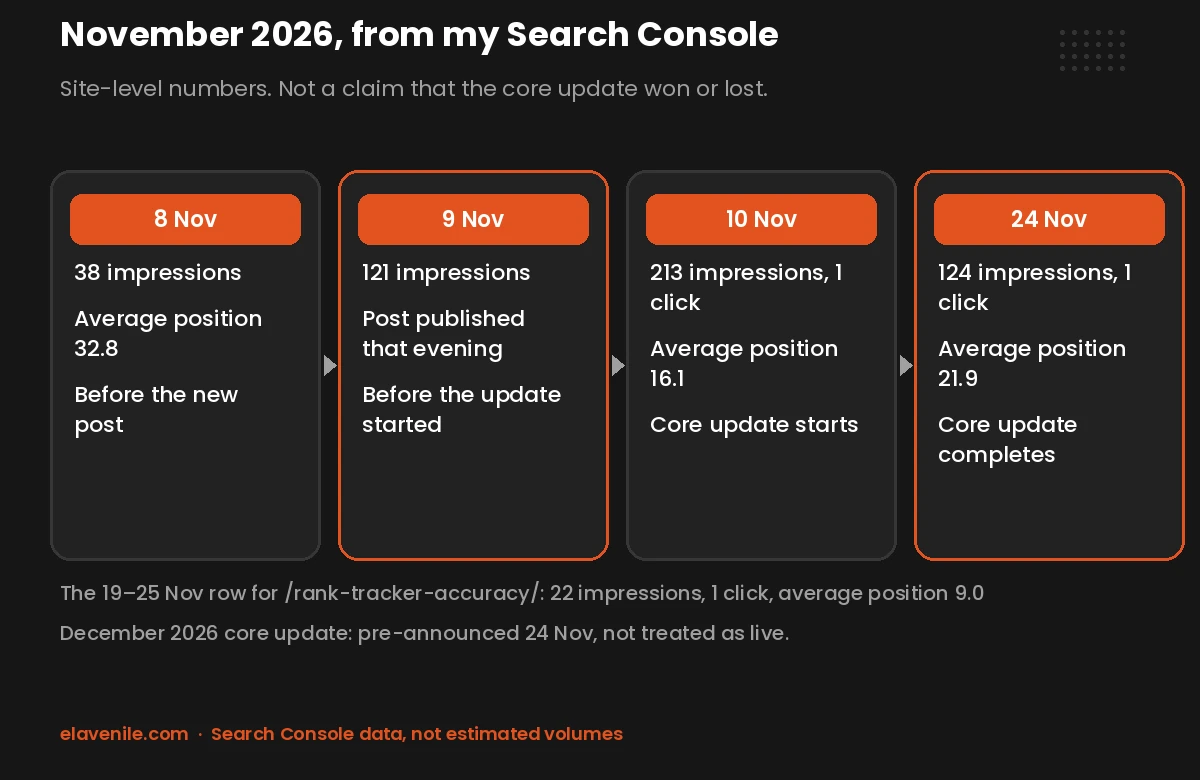
On 9 November 2026 I published ChatGPT Business Hub: What’s Confirmed?. The next day, 10 November, Google started the November 2026 core update, which the Search Status Dashboard incident later marked as completed on 24 November. Site-level Search Console for elavenile.com, around those dates:
- 8 November: 38 impressions, average position 32.8
- 9 November: 121 impressions (the new post went out that evening, before the update started)
- 10 November: 213 impressions, 1 click, average position 16.1
- 24 November: 124 impressions, 1 click, average position 21.9
The rank-tracker-accuracy URL, for 19 to 25 November, showed 22 impressions, 1 click, and an average position of 9.0 in the same Search Console property. That is a useful page-level row. It is not a site-wide story.
What I will not do with those numbers is claim the core update “won” or “lost” anything for me. The impression jump started the day before the update, on a day I published a post. Clicks stayed rare. Average position moved around because the mix of queries changed. That is exactly why I do not read one average-position line on its own, and why I would not let a rank tracker be the first tool I opened that week.
Google’s own core update guidance is more careful than most dashboards. Confirm the update has finished on the Search Status Dashboard. Wait at least a full week after it completes before you analyse the site in Search Console. Then compare that week with a week before the rollout started, and look at top pages and queries, not only the site-level chart. A small position change, Google says, is not a reason to tear up content that is already doing its job.
The first full week after 24 November is 25 November to 1 December. In the US, that week also covers Thanksgiving and Black Friday. I would not treat it as a quiet “after” sample either. I’ll wait for a calmer comparison week, then compare it with a week from before 10 November.
How I’ll watch the next core update
On 24 November 2026, Google also pre-announced a December 2026 core update on the same dashboard, in incident AXrqxXXdtSjj3672ux7X. The incident text said the update was not rolling out. I am not treating it as live, even if a status card looked “Active” for a while in some write-ups.
When it does start, I will not open the rank tracker first. I will mark the start and end dates as annotations, wait until a full week after it finishes, compare Search Console clicks and impressions for the pages that matter against a week from before the rollout, and only then look at tracked keywords, and only the ones I already care about. Same order I use now.
If a page I care about then shows a large, sustained drop in Search Console, I will follow Google’s advice and assess the page, and the site around it, rather than chase a one-day rank in a third-party tool. That work, when I do it for a client, sits on my services page.
FAQ
Should I cancel my rank tracker and only use Search Console?
No. I still want a tracker for a short list of keywords and for competitor context on those queries. I just refuse to let it lead the weekly review, especially during a core update or while poisoned SERPs are still a known issue for some vendors.
Why don’t Search Console and my rank tracker show the same average position?
They are rarely averaging the same thing. Search Console averages the topmost result from your site across the real searches that generated impressions. A rank tracker averages the positions it collected for the keywords you asked it to watch, from the locations and devices you configured. A mismatch is a reason to inspect both, not a reason to throw one of them out on sight.
How soon after a core update should I judge the results?
Google’s current guidance is to wait at least a full week after the update has finished, then compare that week with a week from before the rollout started, looking at top pages and queries in Search Console. I also avoid judging a week that is already noisy for other reasons, such as a major holiday shopping period.
What if Search Console clicks dropped but impressions did not?
That is a CTR question, not automatically a ranking emergency. I check which pages and queries moved, whether a new SERP feature is taking clicks, and whether I published or changed something that altered the snippet. I do not start from a rank tracker screenshot.
If you want help setting up a Search Console-first weekly report, or you need a second pair of eyes after a core update, that is the kind of work I do. You can start on the services page, or book a conversation on the contact page.