How to Show Up in ChatGPT and Google AI, Honestly?
How to show up in ChatGPT and Google AI? I hear that question most often from someone who has typed their own business name into a chat box and not liked the answer.
I use a five-part check. It is the same work I describe on my services page: site structure, useful answers, brand information, structured data and authority signals. Below I walk through that check, then reviews and profiles, then how I measure the traffic. I will also repeat a line from that services page, because it belongs at the front, not the footnote: no one can guarantee an AI mention or a search ranking.
How AI assistants pick sources?
They do not all read the same places, and they do not publish a full recipe.
Google says its generative AI features “are rooted in our core Search ranking and quality systems,” and that Business Profiles help businesses show up “in both AI responses and other Google Search results.” That is from Google’s guide to its generative AI features, which I already walk through in How AI Reads Your Reviews. Google also says AI Overviews and AI Mode “may use different models and techniques,” so a finding about one does not automatically apply to the other.
ChatGPT is a different reader. When it searches the web, it is drawing on pages it can fetch, plus sources it already trusts enough to quote. OpenAI’s help page on ChatGPT search is the place to start for the official version, including the unexciting part: placement is not something you can buy inside an ordinary answer, and it is not guaranteed.
A vendor study is useful here as long as you keep its limits on the page. Cheers, which sells an AI visibility tool, tracked thousands of home-services answers in US and Canadian cities between 31 August and 20 September 2026. In that sample, ChatGPT almost never cited a Google page (0.1% of 9,434 answers) and leaned on directories instead: Expertise.com in 32.1% of answers, Angi or HomeAdvisor in 29.4%, and BBB in 14.5%. The same research found Google AI Mode showed a Google rating and review count for 90% of the businesses it named. Cheers itself says these are associations, not a ranking formula. It is also one vendor, one set of home-services questions, and not a UK sample. I cite the same figures, with the same caveats, in the two review posts linked below.
So I do not treat “get more Google reviews” as a complete ChatGPT plan, and I do not treat a directory mention as a Google AI plan. The checks below cover both, without pretending I can make an assistant say your name.
The 5 checks I run first
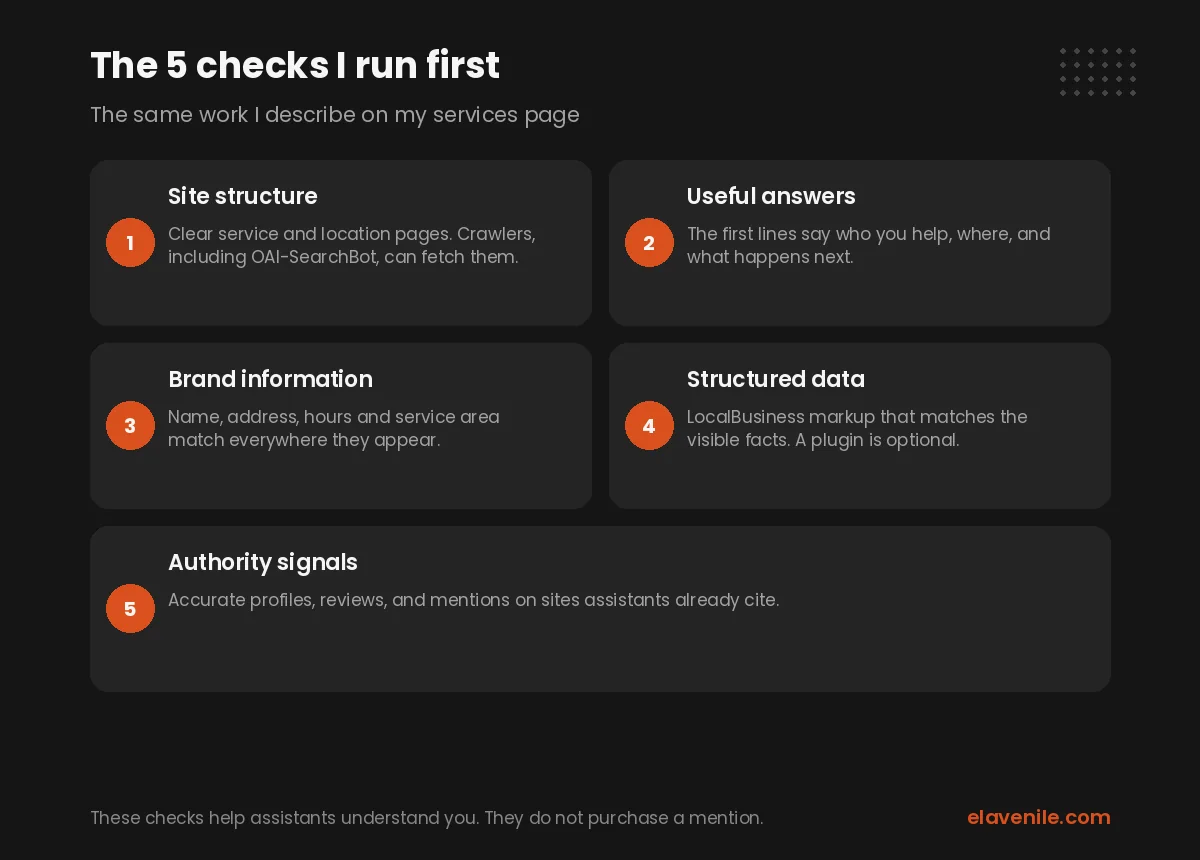
This is the order I work in. It matches the AI search visibility work on my services page.
1. Site structure
Can a person, and a crawler, find a clear page for each service and, if you have them, each location? I look at navigation, internal links, indexability and whether the important pages are buried. If ChatGPT or Google cannot fetch a page, nothing else on this list will rescue it. OpenAI documents its search crawlers, including OAI-SearchBot, on its bots page. I check that those crawlers are not blocked in robots.txt or by a firewall, in the same spirit as I check Googlebot.
2. Useful answers
“Plumbing for growing households” helps no one. “Emergency boiler repair in Leeds, including evenings and weekends” gives an assistant something it can quote. The first few lines should say who you help, where, and what happens next. Pricing or a plain explanation of how pricing works belongs in text, not in a graphic.
3. Brand information
Your name, address, phone number, hours and service area should match on your site, your maps profile and the directories you already use. Assistants get less confident when those details disagree. This is dull work. It also prevents the embarrassing version of AI visibility, where the model recommends you at the old address.
4. Structured data
Markup does not replace the words on the page. It helps software interpret them. For a local or service-area business I use LocalBusiness markup that matches the visible details: address, coordinates, opening hours, and the area you actually serve. I built a small WordPress plugin for that, RankUp Geo-Radius Schema, which adds this markup from an address, coordinates, a service radius and named service areas, without tracking or external requests. It is one way to do the job, not a requirement. The facts on the page still have to be right.
5. Authority signals
This is the work other people can see: accurate profiles, reviews, and mentions on sites an assistant already cites. I come back to reviews in the next section, because the sources differ by assistant. I also look at whether your site is consistent with those third-party pages, so the model is not trying to reconcile two versions of you.
A reported ChatGPT Business Hub has been written up in the trade press, with OpenAI declining to comment. I covered what is confirmed and what is still rumour in ChatGPT Business Hub: What’s Confirmed?. Nothing published says that claiming a profile would change how often you are recommended. I would not wait on a product that has not been announced, and I would not skip the five checks above because a screenshot looked interesting.
Reviews and profiles
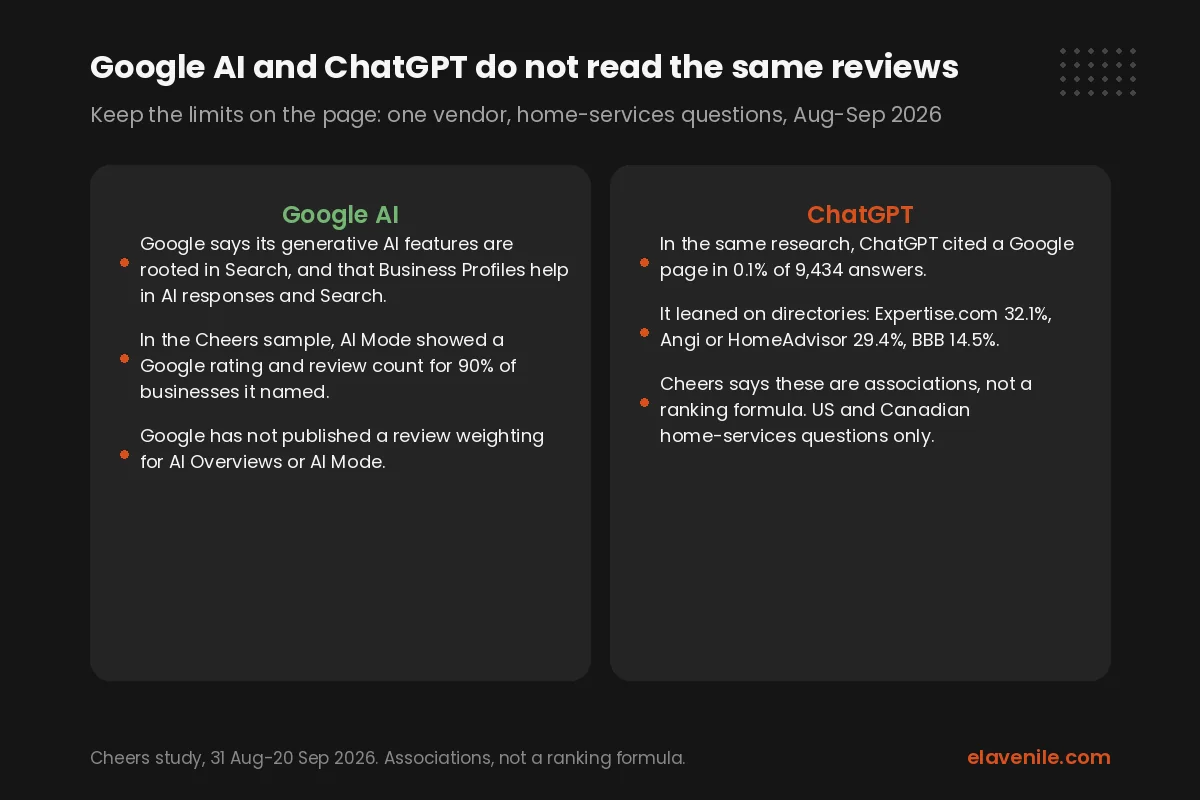
Google AI and ChatGPT do not lean on the same review sources, which is why I wrote a separate guide for each half of this problem.
For Google AI, Business Profile reviews sit close to the experience. In the Cheers sample above, AI Mode often displayed a Google rating next to the businesses it named. Google has not published a weighting for reviews inside AI Overviews or AI Mode, so I treat reviews as part of a complete, accurate profile, not as a lever I can promise will change an AI answer. How AI Reads Your Reviews has the longer version, including the dated sources.
For ChatGPT, the same research pointed at directories more than at Google. Yelp has also been reported as licensing review content to ChatGPT; that is a news report, not a public official recipe, and I flagged it as indirect in Best Review Sites for Small Business in US vs UK. The practical step is still simple: be accurate and active on Google, then add the one or two review sites your customers already use in your country and industry. I would not open six new profiles for an assistant that might never mention them.
BrightLocal’s 2026 consumer survey of 1,002 US adults, which I also cite in those review posts (last checked there on 20 October 2026), found 45% had used AI tools for local business recommendations, up from 6% the year before. Among those AI users, 88% said they fact-check the reviews the tools cite. So even a mention sends people back to your real profile. The profile has to hold up when they arrive. It is a US survey. UK readers should take it as a direction, not a census of Britain.
How I measure it
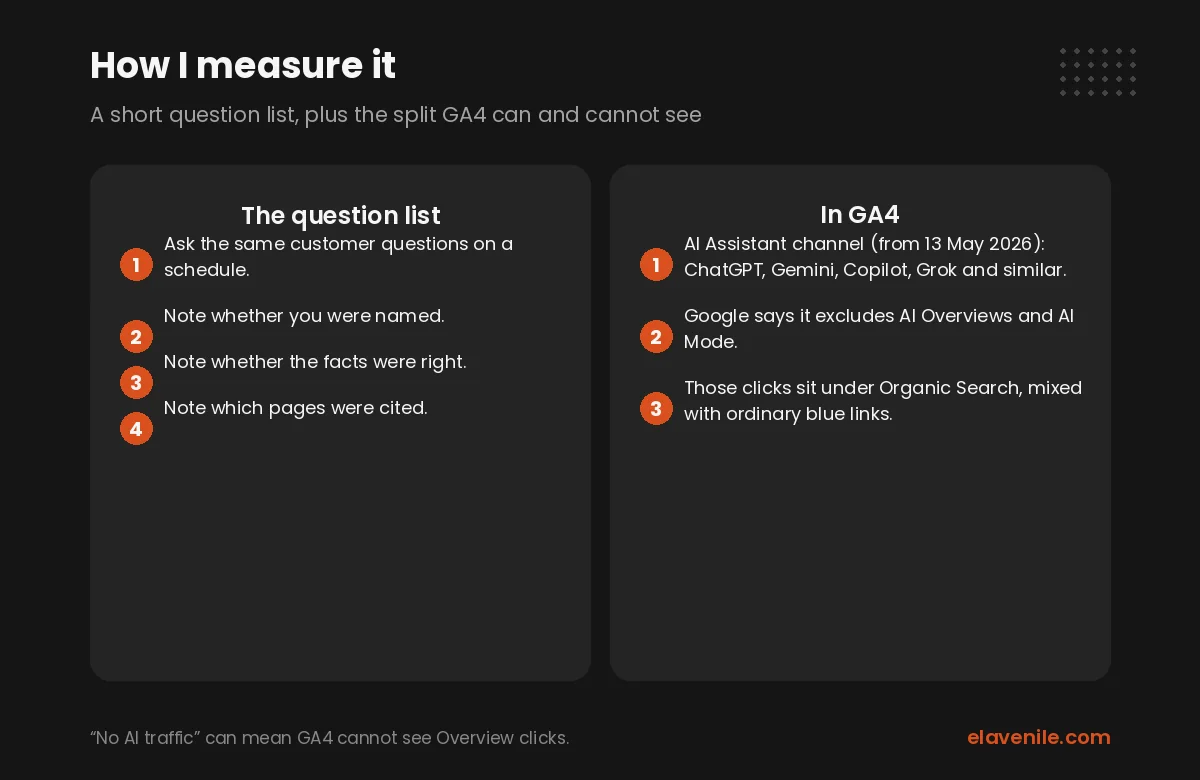
I do not use a chat window as my only report. I keep a short list of customer questions, ask them in ChatGPT and in Google on a schedule, and write down whether I was named, whether the facts were right, and which pages got cited.
For traffic, I use the method in How to Track AI Traffic in GA4. Since 13 May 2026, GA4 has had a built-in AI Assistant channel for visits from tools such as ChatGPT, Gemini, Copilot or Grok. Google says that channel excludes Google’s AI Overviews and AI Mode. Clicks from those Google features are filed under Organic Search, mixed with ordinary blue links. So “we got no AI traffic” can mean “GA4 cannot see the Overview clicks,” not “nobody found us there.”
FAQ
How to show up in ChatGPT if I already rank in Google?
Ranking in Google helps, especially for Google’s own AI features, which are tied to Search. ChatGPT may still skip you if it cannot fetch your pages, if your service pages are vague, or if the directories it leans on do not mention you. Do the five checks, then look at the sources in How AI Reads Your Reviews.
Can I pay to be recommended by ChatGPT or Google AI?
You can pay for advertising in some Google surfaces, and OpenAI has discussed sponsored formats separately from ordinary answers. I am not treating a paid placement as the same thing as an organic mention. For ordinary answers, OpenAI’s own help page does not offer a submission form that guarantees a recommendation, and I will not pretend I have one.
Does the Geo-Radius Schema plugin make ChatGPT mention me?
No. It helps you publish accurate LocalBusiness structured data. That is one part of the structured-data check. It does not purchase a mention, and I would not install it instead of writing a clear service page.
How to know whether this is working?
Keep the question list and the GA4 split I described. Look at whether assistants describe you accurately, and whether AI Assistant traffic appears in GA4. Do not expect a tidy “AI Overview clicks” row. Google does not give you one.
Your next step
If you want me to check how AI tools describe your business, I can start with this same five-part pass. Book a free consultation on the contact page. I also have a free 7-day AI visibility guide if you would rather begin on your own; ask me for it when you write.