How to Value a Website From the 4 Exits I Actually Sold?
How to value a website? Most guides hand you a formula and a typical range. I can add something more limited, and more useful: four sales I completed, with the figures already on this site, and a plain explanation of what a “multiple” means.
This page is the hub for those four write-ups. It puts them in one table so you can see why a cheap domain, a content portfolio, an authority niche site and a solo tech blog were priced differently. It is not a promise that your site will sell on the same terms. If a number below matters to you, open the original case study. That is where the detail lives.
What a website valuation multiple means
A multiple is a shorthand for price. Someone looks at a measure of earnings, usually profit, and multiplies it by a number that reflects risk, quality and how easy the asset is to take over.
The unit matters more than the adjective. Two of my sales were priced as a multiple of monthly net profit: 26X for an authority niche site, and 35X for a solo tech blog. That is not 26 or 35 times a year of profit. If you think in years, 26 times one month of profit is a little over two years of profit, and 35 times is a little under three, before a buyer starts adjusting the earnings themselves. I am doing the arithmetic from the monthly figures I published. I am not adding a marketplace average on top.
The other two sales were not priced that way at all. The domain had almost no operating profit to multiply. The buyer paid $2,610 for the name. The multi-niche portfolio sold for a combined $8,000 in cash, after it had already produced $7,000+ in AdSense and affiliate income.
If someone quotes you “a 30X multiple” and does not say monthly or annual, or profit or revenue, ask them to finish the sentence. A lot of confusion starts there.
The 4 exits, in one table
All four figures are from my own sites and transactions, as reported in the linked posts. They describe those sales. They are not a formula for yours.
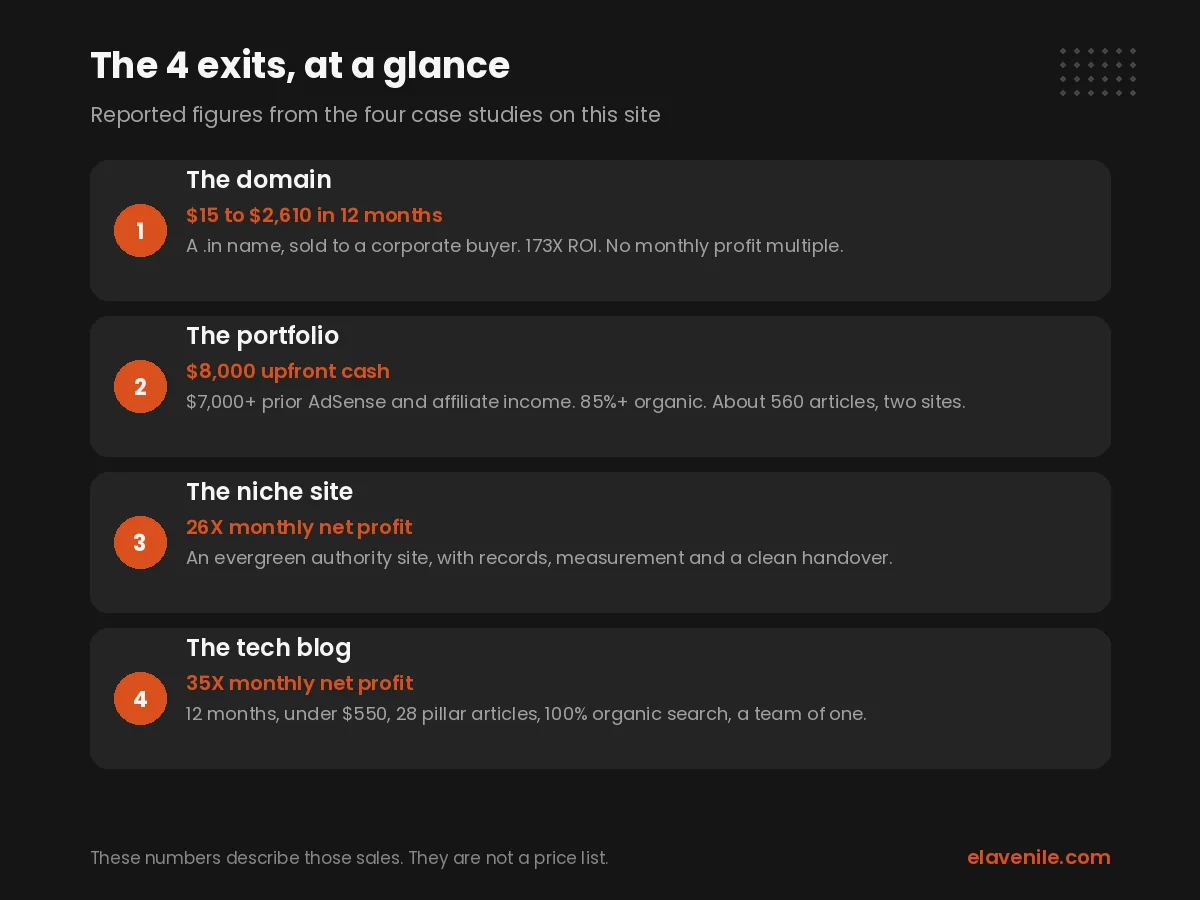
| Asset | What I sold it for | Other reported figures | Case study |
|---|---|---|---|
| Domain (.in) | $2,610 after 12 months | Bought for $15. 173X ROI. | How I Sold a $15 Domain for $2,610 |
| Multi-niche portfolio | $8,000 upfront cash | $7,000+ prior AdSense and affiliate income; 85%+ organic; about 560 articles across two sites. | How I Sold a Website Portfolio for $8,000 |
| Authority niche site | 26X monthly net profit | Evergreen niche. I aimed for 90+ PageSpeed scores. | How I Sold a Niche Website at a 26X Multiple |
| Solo tech blog | 35X monthly net profit | 12 months; under $550; 28 pillar articles; 100% organic search; a team of one. | How I Sold a Tech Blog at a 35X Multiple |
A few notes that are easy to skip and should not be.
The domain post is clear that the original working title rounded the sale to $2,600, and that the settlement in the transaction record was $2,610. I am using $2,610 here for the same reason.
The portfolio “prior revenue” figure is $7,000+ from AdSense and affiliate income across the life of the project, not a single year’s profit. The $8,000 was an upfront cash payout for the two core sites.
The 26X and 35X figures are monthly net profit multiples from those two sales. The tech blog also stayed inside a $550 budget for hosting, domain and some supplemental writing, published 28 pillar articles of about 2,000 words each, and earned its traffic from organic search only, with a team of one. Those details belong to that project. They are not a template I would force onto a local service business.
What raised the multiple?
I cannot point to a buyer’s spreadsheet and show you the exact line that added points. What I can do is look at the four sales together and say which traits I would still work on.
Evergreen demand helped the niche site. I looked for a vertical with a long demand outlook, not a short-lived trend, and wrote so I could update guides as products changed without rebuilding the site. A buyer can get more comfortable when the audience is still going to have the same problem in ten years.
Depth helped the tech blog. I did not try to out-publish large technology sites. I wrote fewer, longer pages around narrower commercial questions, in clusters, and kept the technical side clean enough that the pages were usable. That approach also fits Google’s guidance on helpful, reliable, people-first content.
Evidence helped both of the content-site sales. Clean records, traffic that can be checked, and a handover a new owner can follow make an asset easier to buy. The niche-site post walks through operational records, measurement, and escrow. The tech-blog post makes the same point in different words: evidence makes an asset easier to sell.
The portfolio adds a different kind of comfort: two sites, 85%+ of traffic from organic search, more than one income source, and a publishing system a buyer could understand. It also shows the trade-off. Every extra site needs research, publishing, technical checks and measurement, so I kept the operating basics familiar across both.
The domain sale is the odd one out, and that is the point. There was no content engine and no monthly profit multiple. The name was short, commercially relevant, held for 12 months, and sold because it fitted a corporate buyer’s plans. I negotiated from that use, not from the $15 registration cost. The opening hint was around $200. I anchored at $3,000 and settled at $2,610. A content site and a domain are valued with different questions, even when the same person sells both. For anyone checking a name today, ICANN’s lookup service helps you read registration records. It does not value the domain for you.
What I would work on before selling again
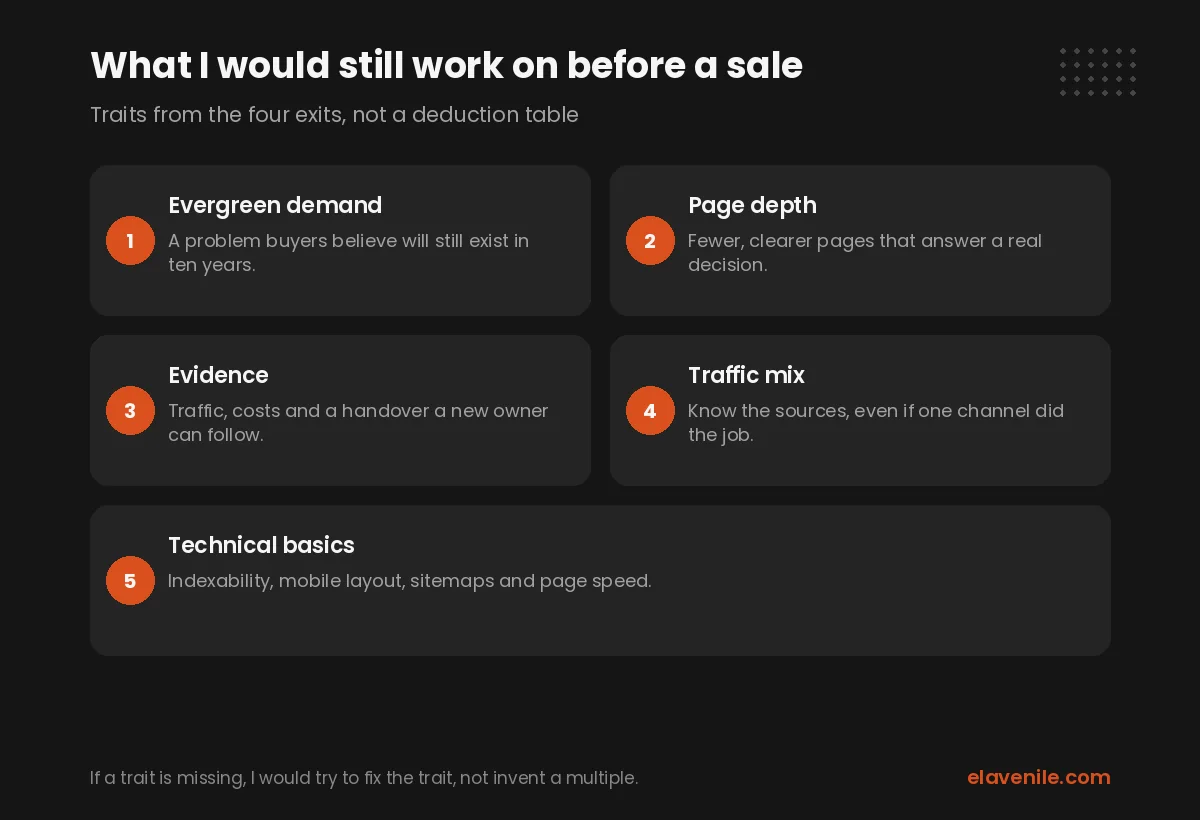
If a trait is missing, I would not invent a multiple to cover the gap. I would try to fix the trait.
Single-channel traffic is one I would look at hard, even though the tech blog was 100% organic and still sold at 35X monthly net profit. That sale had tight scope, strong pages and a short, documented history. I would not treat “Google sends all the visits” as a strength on a site I could not explain that clearly.
Thin pages, messy analytics, a site that only I know how to update, or a niche that is already fading: those are the things I would expect a careful buyer to discount. I am describing judgement, not a published deduction table.
Page speed sits in that same group. On the niche site I aimed for 90+ PageSpeed scores and used Core Web Vitals as a practical checklist. Speed does not replace useful content. A slow page makes every other improvement harder to benefit from. The current definitions are in web.dev’s Web Vitals documentation.
A pre-sale checklist I would run today
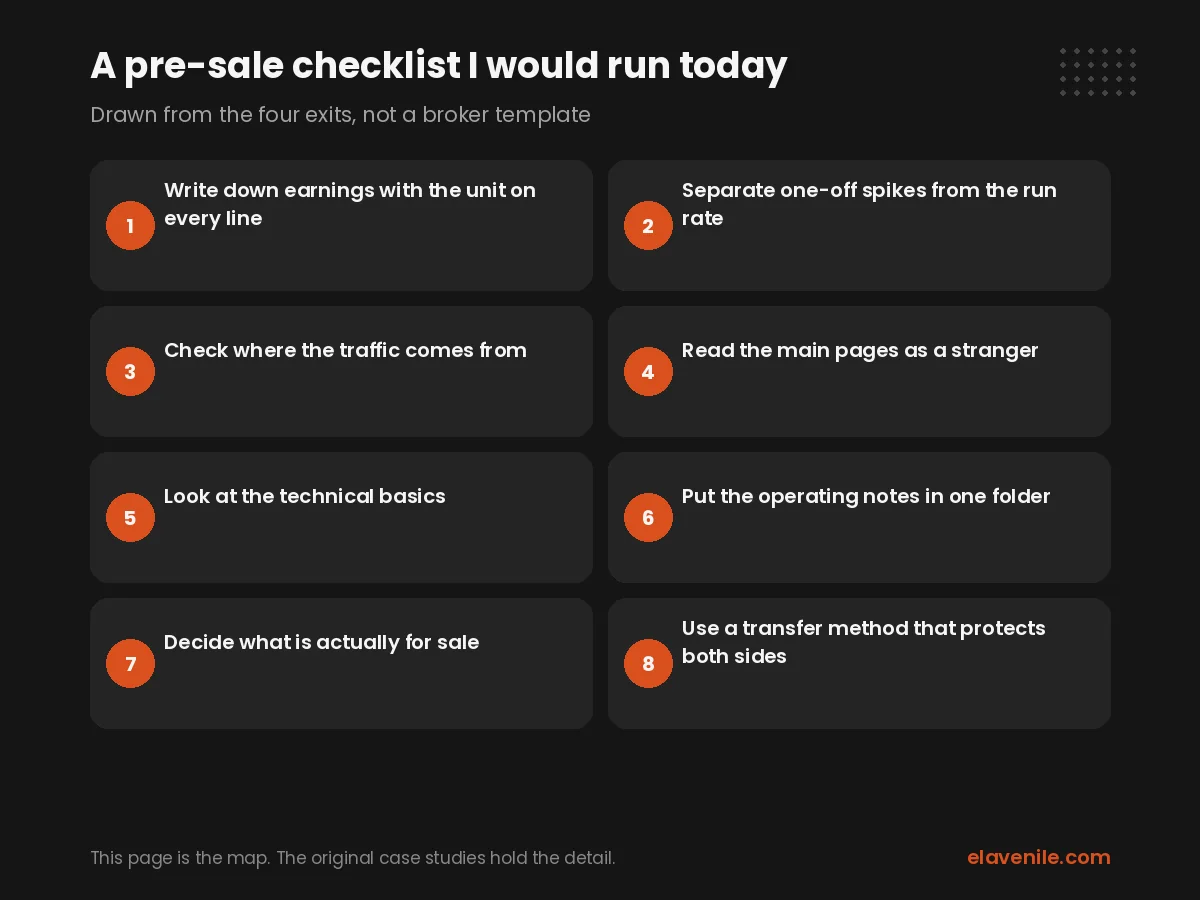
This is the list I would walk through before I tried to price something now. It is drawn from the work in those four posts, not from a broker’s template.
- Write down the earnings in one place, with the unit on every line: monthly or annual, profit or revenue, and over what period.
- Separate one-off spikes from the run rate. A good month is not a valuation.
- Check where the traffic comes from, and how much of it would still arrive if one source wobbled.
- Read the main pages as a stranger. Do they answer a real question, or do they only exist to collect visits?
- Look at the technical basics: indexability, sitemaps, mobile layout, broken links, and page speed.
- Put the operating notes in a folder a buyer could open without me on a call: costs, revenue proofs, content inventory, and how the site is updated.
- Decide what is actually for sale. A domain, a single site and a two-site portfolio are different assets.
- Use a transfer method that protects both sides. On the niche-site sale I used escrow.
If you want the longer version of any row, use the original post. This page is the map, not the case study. The four write-ups also sit together under case studies.
FAQ
How to value a website if I only have last month’s profit?
Don’t. Use a stretch of months, note anything unusual, and say whether you are talking about profit or revenue. One strong month is a data point, not a price.
Is a 35X multiple better than a 26X multiple?
Not automatically. Those two figures are both monthly net profit multiples, from different sites, with different histories. The 35X tech blog was a 12-month, tightly scoped project. The 26X niche site was built as an authority property in an evergreen category. Compare the assets, not just the multipliers.
How to use these examples without copying the prices?
Treat them as worked examples. If your site is a local service business with a team, a shop, or a short trading history, it is not the $15 domain and it is not the 28-article tech blog. Use the checklist, then do the arithmetic on your own numbers.
Should a blog and a domain be valued the same way?
No. The domain sale was about a name and a specific buyer. The content sites were about traffic, earnings, records and how easy the operation was to take over. If someone applies a content-site multiple to a bare domain, or the other way around, the number will look precise and still be wrong.
Your next step
If you are thinking about selling, or growing something so it could be sold, I can look at the messy version with you: the traffic mix, the records, and whether the asset is even ready to price. Tell me about it via the contact page.